
Commercial Vehicle Fleets: Coverage Questions for Work Trucks
Two recommendations can sound equally sensible while addressing different underlying conditions. Business vehicles have usage patterns unlike household cars. For a reader evaluating alternatives, the practical question is what evidence supports the recommendation, not which option has the strongest sales language.
For business insurance, the best choice is often the one with the most clearly defined scope, not simply the lowest apparent initial price. Practical access, upkeep and limitations should all appear in that scope.
Understand the real problem before choosing a solution
The headline price, rate or premium is not the complete economic decision. The written terms, exclusions, time horizon and realistic cash reserve determine whether an option fits the reader circumstances.
Business vehicles have usage patterns unlike household cars. Ask which observation would confirm that explanation and which finding would change it. This is especially important when a product specification, inspection report or estimate is presented without the conditions that led to it.
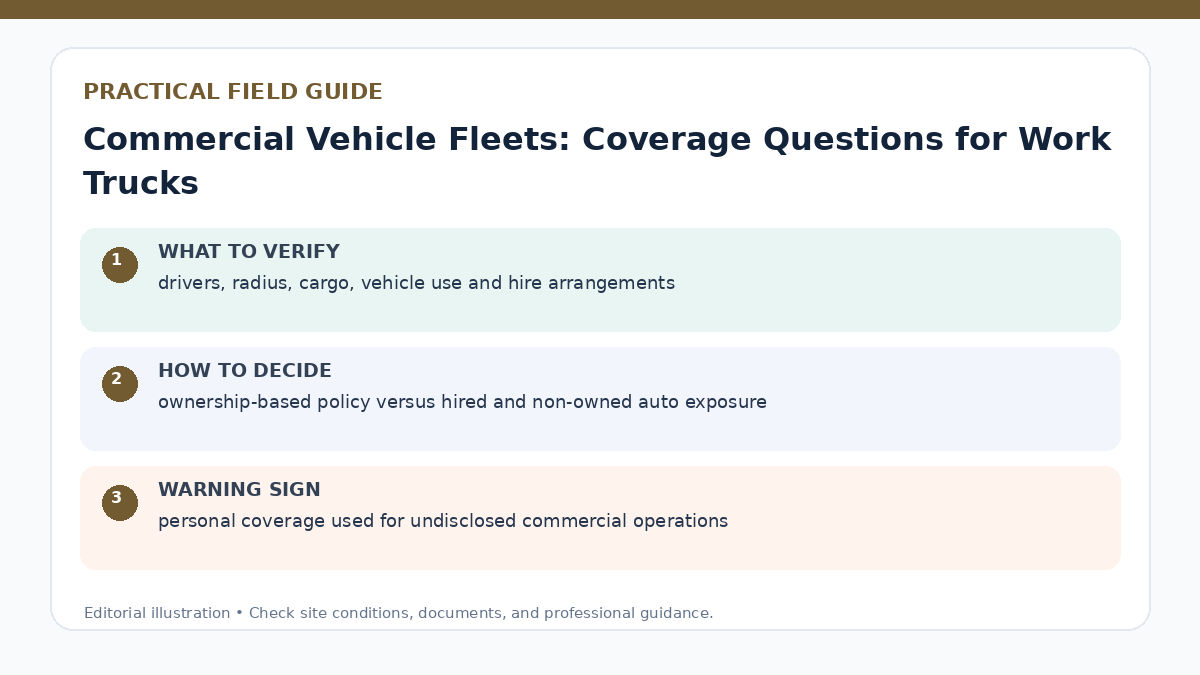
Four details worth checking
- Drivers: Ask how it was checked, whether a measurement or document is available, and what remains uncertain.
- Radius: Confirm that the proposed scope includes this issue rather than assuming somebody else will handle it.
- Cargo: Write down any access, maintenance or verification requirements before agreeing to the work.
- Vehicle use and hire arrangements: Record the existing condition and request a clear explanation of why it matters to this decision.
These checks are intentionally more useful than a generic list of features. For example, a provider should be able to distinguish an observation about drivers from a recommendation that addresses radius. If the connection is missing, request clarification before deciding.
How to compare realistic options
Ownership-based policy versus hired and non-owned auto exposure. Compare proposals on the same scope, using the same assumptions. Write down what each option includes, excludes and requires from the owner or user. A low figure is not a bargain if essential work, monitoring or follow-up is absent.
Make the comparison at three levels: the immediate task, the consequences of delaying or doing less, and the likely maintenance or follow-up afterward. Any promised outcome should be described in terms that could later be verified. Where a professional assessment is needed, an educational checklist cannot replace it.
A practical decision sequence
- Describe the starting point. Collect photographs, measurements or records related to drivers; include dates and the conditions under which the issue appeared.
- Verify the explanation. Ask what inspection establishes radius and whether an alternative cause has been ruled out.
- Define the work or choice. Confirm how the proposed option deals with cargo, including responsibility for associated work.
- Compare total obligations. Use ownership-based policy versus hired and non-owned auto exposure as a prompt to consider cost, time, risk and ongoing attention.
- Keep the evidence. Save the estimate, product details, findings and any warranty or follow-up instructions in one place.
Warning signs and common mistakes
A warning worth taking seriously is personal coverage used for undisclosed commercial operations. It does not automatically prove that a provider or product is unsuitable, but it means the decision is missing a piece of information. Ask for the missing detail in writing and compare the explanation with the actual condition.
Policy language, exclusions and local law govern coverage; generalized comparisons are educational, not an individual insurance determination. Recommend licensed agent and policy review. Distinguish a normal tradeoff from a safety issue: the first may be a matter of budget or preference, while the second should be addressed before work proceeds. For claims about local permits, warranties, eligibility or health effects, check an appropriate professional or primary source.
Questions to ask before committing
What evidence supports this recommendation?
Request the observation or document relating to drivers and ask how it changes the recommended scope. A concrete answer should explain both the finding and its limitation.
Which part of the proposal makes the biggest difference?
Compare ownership-based policy versus hired and non-owned auto exposure. Ask whether a lower-cost alternative would resolve the same underlying issue, and whether a more expensive approach offers a measurable benefit.
What could cause the result to fall short?
Discuss personal coverage used for undisclosed commercial operations and any uncertainty about hidden conditions, timing or use. Agree on what will be inspected, recorded or revisited if results differ from expectations.
Bottom line
Business vehicles have usage patterns unlike household cars. The strongest next step is to gather specific evidence, compare a written scope on consistent terms and treat unverified assumptions as open questions—not facts. This approach supports more informed decisions while leaving technical judgments to the qualified people responsible for them.
Further reading
For background and official guidance, start with NAIC Consumer Resources. Confirm any location-specific rule, safety requirement, eligibility term or product claim before acting. This article is general educational information, not a personalized assessment.